

Baku Ateshgah Fire Temple and Yanar Dag: Visitor Guide
Summarize this guide with AI
Review the key points quickly in the AI tool you prefer.
Gemini opens the app and copies the prompt to your clipboard; paste it into the window that opens. If copying fails, take the prompt from below.
Copy the prompt by hand
Ateshgah and Yanar Dag are two separate fire sites on the Absheron Peninsula near Baku. Yanar Dag burns on natural gas. Ateshgah is a temple complex from the 17th and 18th centuries. Its natural flame went out in 1969, and the fire you see today runs on gas from the city network. On our Baku tour both come in one optional trip, 55 USD per person.
Key facts
Ateshgah: Surakhani, near Baku, a complex from the 17th and 18th centuries
Yanar Dag: a hillside on the Absheron Peninsula with a natural gas flame
Entry fee and hours: sources disagree, confirm at the gate
On the tour: Yanar Dag and Ateshgah trip is optional, 55 USD
Visa: none for up to 90 days with a Turkish passport
Where are Ateshgah and Yanar Dag, and how do they differ?
Both lie outside central Baku. Ateshgah is in the Surakhani district. Yanar Dag is on a hillside on the same peninsula. Visitors often combine them in one trip, but they show different things.
| Ateshgah | Yanar Dag | |
|---|---|---|
| What it is | A temple complex with a stone courtyard | A natural gas flame on a hillside |
| The flame | Fed by city gas today | Fed by gas seeping from the ground |
| What you see | Cells, the courtyard, the altar in the middle | The slope, an amphitheatre, a museum |
| Protection | State historical-architectural reserve since 19 December 2007 | State reserve since 2 May 2007 |
Ateshgah: did the eternal fire really go out?
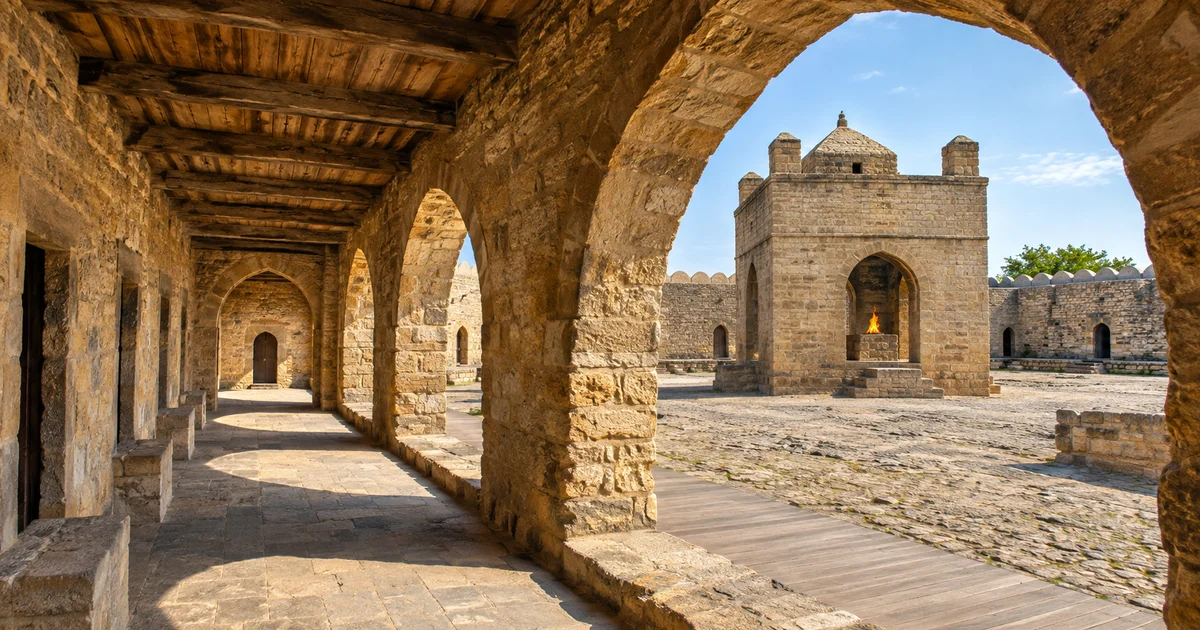
The short answer is yes, the natural flame went out. Wikipedia says the complex was built in the 17th and 18th centuries, and inscriptions on it date from 1668 to 1816. The natural eternal flame was extinguished in 1969. The complex became a museum in 1975. The flame on show now is kept alive with piped gas from the Baku mains.
That does not make the visit empty. You walk through the cells, past the altar in the middle and the exhibition notes in the courtyard. Our experience page describes a courtyard once linked with Zoroastrians and communities that honoured fire, plain but striking. Reading the notes in the cells adds to the visit.
Yanar Dag: a natural gas flame
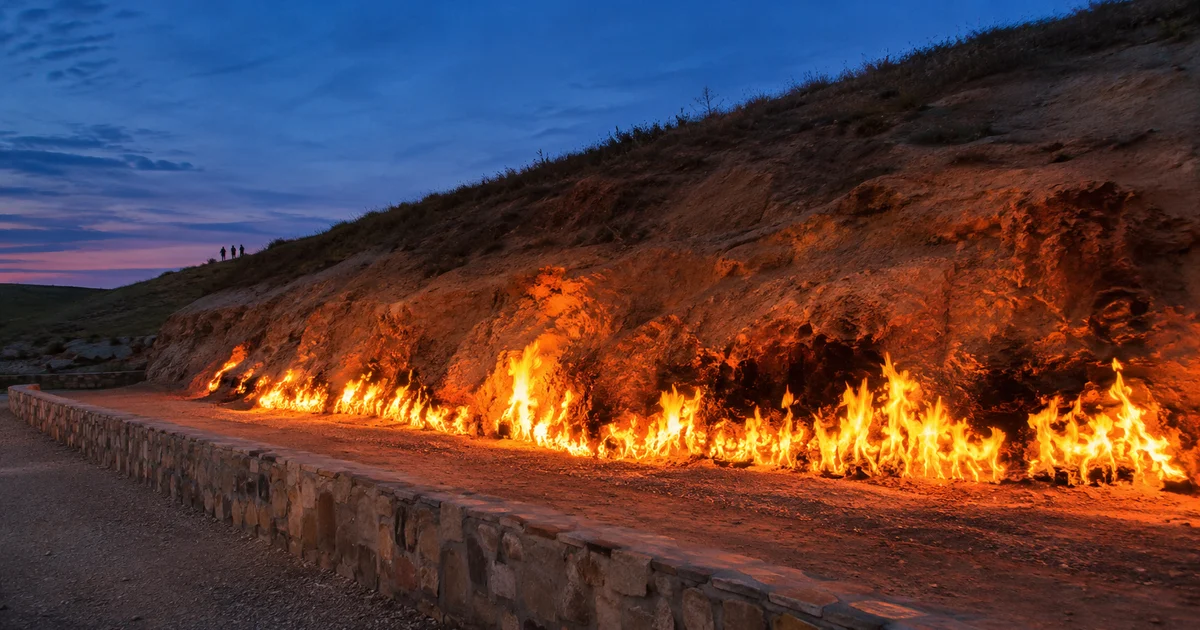
At Yanar Dag the flame feeds on gas that seeps from the hillside. Unlike a mud volcano, there is no mud or liquid. The site became a 64.55 hectare state reserve by decree on 2 May 2007. It holds a 500 seat amphitheatre and a museum. The museum opened in the 2017 to 2019 renovation.
How long the flame has burned is disputed. Local accounts say a shepherd lit it by accident in the 1950s. Other accounts speak of 4,000 years. We give no figure. Our experience page says the flame looks clearer in the evening and the breeze on the hill can be cool. Do not get too close to the flames and keep a close eye on children.
Entry fee and opening hours
We could not reach the official tourism page, so we could not confirm the current fee or hours. Travel guides give a foreign visitor fee for Ateshgah anywhere from 4 to 15 manat. Opening times are given as 9 am or 10 am, closing at 6 pm or 7 pm. Because the figures conflict, we give no number.
Check Azerbaijan's official tourism site before you go, or ask your guide if you travel on a tour. The tour price does not include museum and site entry fees. The page does not say whether the 55 USD optional trip covers the entry fee, so ask our sales team before you book.
Ateshgah and Yanar Dag on a Baku tour
The Pearl of the Caspian tour lasts 3 nights and 4 days. You fly from Istanbul with Turkish Airlines: TK 332 at 8.35 am out, TK 341 at 5.45 pm back from Baku. You stay at the 4 star Wyndham Hotel Baku with breakfast. The programme includes a panoramic Baku city tour.
Optional trips run in your free time and none is included in the price: Old City tour 30 USD, Modern Baku 40 USD, Yanar Dag and Ateshgah Temple trip 55 USD, Gobustan 60 USD and Azerbaijan night tour 75 USD. City tourist taxes and tips of 50 USD are collected by the guide on the first day.
Departures run from 30 December 2026 to 17 May 2027. The price starts at 549 USD per person in a double room. Departures on 23 January, 4 February, 8 March and 9 March cost 599 USD. Departures on 27 January, 22 April and 15 to 17 May cost 649 USD.

Baku Pearl of the Caspian Tour 2027 | 3 Nights, Turkish Airlines, Winter Season
Before you go
Turkish citizens need no visa for up to 90 days. The Ministry of Foreign Affairs says tourists coming directly from Turkey can also enter with an ID card. On the tour you travel with a passport.
In autumn and winter the wind in the courtyard and on the hill is cool. Dress warmly.
Our tour page places Gobustan 64 km south east of Baku and lists it as a UNESCO World Heritage site. Add it if you want a half day more.
Comfortable shoes are enough. Keep quiet and respectful at Ateshgah.
More on Baku and the region.
Frequently asked questions
Where is Ateshgah?
Ateshgah is in the Surakhani district of Baku, outside the city centre. On our Baku tour it is an optional trip.
What is Yanar Dag?
A flame fed by natural gas that seeps from a hillside on the Absheron Peninsula. The site has been a state reserve since 2007.
Did the Ateshgah flame really go out?
The natural flame went out in 1969. The fire shown today runs on gas from the Baku network. The complex has been a museum since 1975.
How much is the Ateshgah entry fee?
Travel guides give 4 to 15 manat and we could not confirm an official figure. Check the official tourism site or the ticket office before you go.
Is Ateshgah or Yanar Dag part of the Baku tour?
Yes, as an optional trip. The Yanar Dag and Ateshgah Temple trip costs 55 USD per person and is not included in the tour price.

Baku Pearl of the Caspian Tour 2026 | Turkish Airlines, Autumn and Winter Season
Prices, hours and departure dates can change. Check the tour page and official sources before you decide.