


Northern Lights in Iceland: 2026-2027 Winter Season Tour Guide
Summarize this guide with AI
Review the key points quickly in the AI tool you prefer.
Gemini opens the app and copies the prompt to your clipboard; paste it into the window that opens. If copying fails, take the prompt from below.
Copy the prompt by hand
The best time to see the northern lights in Iceland is September to April, when the nights are long and dark. This is the advice of Visit Iceland, the country's official tourism board. Iceland sits roughly in the middle of the aurora belt that circles the pole between 60 and 75 degrees north. On a clear, active night you can see the lights even from Reykjavik. Nothing is guaranteed: darkness, clear skies and enough solar activity have to line up on the same night. Our Iceland northern lights tour is a seven-night, Reykjavik-based trip with December 2026 departures from Istanbul, and it offers aurora outings as optional evening extras.
What the northern lights actually are
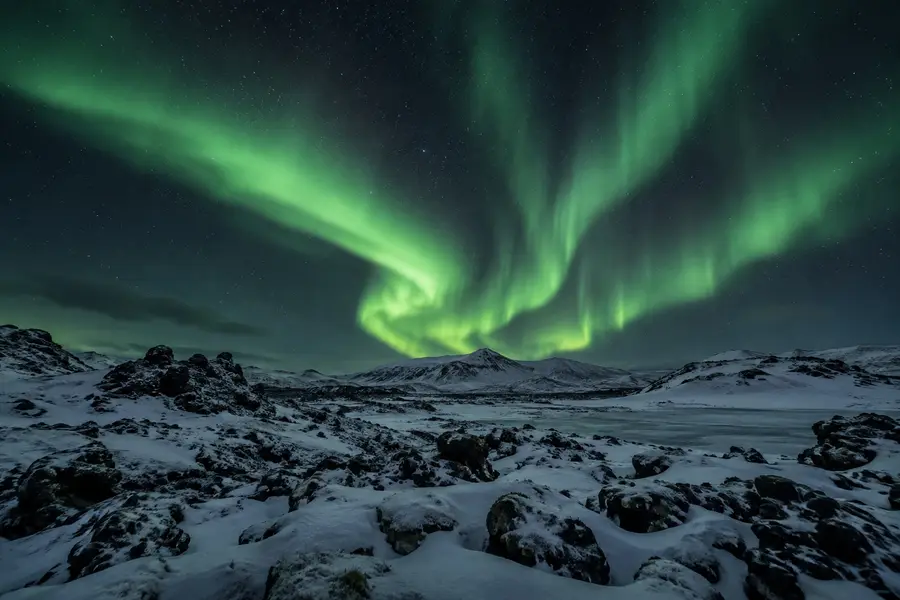
According to Visit Iceland, the aurora borealis forms when particles carried by the solar wind interact with the Earth's magnetic field. The released energy produces sheets of green and purple light across the sky. The name combines Aurora, the Roman goddess of dawn, and Boreas, the Greek word for the north wind.
Visit Iceland's Reykjavik guide describes the aurora belt as a ring around the top of the globe, with Iceland roughly in the middle of it. The lights can appear at any hour and in any month; what makes them visible in Iceland is the darkness of winter.
When to go
The official source says activity tends to be livelier around the equinoxes in September and March. Midwinter gives you more hours of darkness to try. The aurora is usually strongest around midnight and in the few hours either side of it. Our tour's December departures fall in the weeks with the longest nights.
Temperatures matter for a night outside. Our Reykjavik pages use monthly averages from past years. They show daytime highs of 7 degrees in October, 4 in November and 2 in December and January. Nights drop to minus 3 in December and January. Dress for hours of standing still.
How to read the sky
- Dark and clear: you need darkness first, and at least some breaks in the cloud, ideally towards the north.
- Forecasts: Visit Iceland recommends checking cloud cover and aurora activity on the Icelandic Met Office site and Auroraforecast.is. The Met Office's daily forecast uses a 9-level scale. The official guide notes activity usually hovers around level three. Anything beyond level five is a rare solar storm.
- Get away from light pollution: according to the official source, chances improve noticeably once you are outside town, especially away from the capital's own lights.
- Be patient: activity usually starts as a faint green arc towards the north before it brightens and starts to move.
Where to look around Reykjavik
Visit Iceland notes the lights rarely outshine the city's street lighting. You do not have to go far, because Reykjavik has parks and reserves without street lights. The official guide suggests:
- Grótta lighthouse: a coastal walk of about an hour from the city centre to the tip of the peninsula. The car park overlooking the lighthouse fills up when the forecast is promising.
- Öskjuhlíð hill: the official guide calls it a good spot to see the lights over the Reykjavik skyline.
- Heiðmörk nature reserve: quieter; reachable by public transport to Norðlingaholt, though a car makes it easier.
According to the official guide, standard aurora tours from Reykjavik last about three hours. They start with a 30-minute drive to dark areas such as Lake Kleifarvatn or the Bláfjöll mountains. On a cloudy night, the Wonders of Iceland exhibition at Perlan and the Northern Lights Center at Grandi both offer simulations of the display.
Aurora viewing on our tour
Our Iceland northern lights tour, Explore Iceland's Northern Lights in 7 Days, is Reykjavik-based. According to the tour page, it flies from Istanbul Airport via Prague to Reykjavik. You spend 7 nights at the 3-star Hotel Klettur, or a similar group hotel, in central Reykjavik. Current departure dates and prices are on the tour page.
Aurora viewing is not on the included list; it appears in the itinerary as an optional extra. The tour page offers a Thingvellir aurora watch on the evening of the Golden Circle day. It also offers a night trip to the unlit lava fields around the Blue Lagoon and the Reykjanes Peninsula. If the weather is right, the guide can also arrange a short viewing outing at extra cost. Which evening each one runs depends on the forecast, so ask us before you book.

Daytime itinerary
Days are built around optional excursions too. The Golden Circle day covers Thingvellir National Park, the Geysir geothermal area where Strokkur erupts every 5 to 10 minutes, and Gullfoss waterfall. The South Coast day walks behind the curtain of Seljalandsfoss and visits Skógafoss and the black sand beach at Reynisfjara. A Snæfellsnes Peninsula day with Kirkjufell mountain and Djúpalónssandur beach, the Blue Lagoon, and a 3-hour whale watching boat trip are also optional.
Thingvellir and Reykjanes
According to Visit Iceland, Thingvellir lies in the rift valley between the North American and Eurasian plates, a 40-minute drive from Reykjavik. Iceland's first national park was founded there in 1928, and the area is a UNESCO World Heritage Site. Groundwater filling the valley forms Þingvallavatn, the country's largest natural lake. The park is open around the clock with no entrance fee, though there is a parking charge for vehicles. The whole Reykjanes Peninsula is a UNESCO Global Geopark. Moss-topped lava fields cover most of it. The junction between the two plates is easier to see there than anywhere else.
What is included
- Included: round-trip flights (one 20 kg bag), 7 nights with breakfast, airport transfers, Turkish-speaking guiding, mandatory travel insurance.
- Not included: lunch and dinner, optional excursions, drinks and personal expenses, tips, the Schengen visa and the Turkish departure tax.
- Visa: the tour page states Iceland requires a Schengen visa, with an exemption for green passport holders. Your passport must be valid for at least 6 months after return.
Photographing the northern lights
- Keep it still: Visit Iceland recommends a sturdy tripod and a cable release. Without one, set the self-timer to a 2 to 10 second delay.
- Starting settings: the official guide suggests ISO 800 to 3200, aperture f/2.8 to f/5.6 and exposures of 15 to 30 seconds. This is a reliable starting point.
- Skip the filters: according to the official source, lens filters can distort the image; manual focus set to infinity usually works best.
- A phone can work too: according to the official guide, smartphones can also capture the aurora. Test your settings before you leave; adjusting them with cold fingers is hard.
For Iceland and more nature-focused holidays, see:
Which months can you see the northern lights in Iceland?
According to Visit Iceland, from September through April. The equinox months of September and March tend to be livelier. December and January have the longest nights.
Is seeing the northern lights guaranteed?
No. The official source states that darkness, clear skies and enough solar activity all have to line up, and chances improve away from town lights.
Can you see the northern lights from Reykjavik?
On a clear, active night, yes, though they rarely outshine the street lights. Visit Iceland suggests Grótta lighthouse and the Heiðmörk nature reserve.
Does the tour include an aurora tour?
No, it is not on the included list. Thingvellir and Reykjanes aurora nights are offered as optional extras, and which evening they run depends on the weather.
When does the tour depart?
The tour departs from Istanbul, with 7 nights in Reykjavik; current dates are on the tour page.